
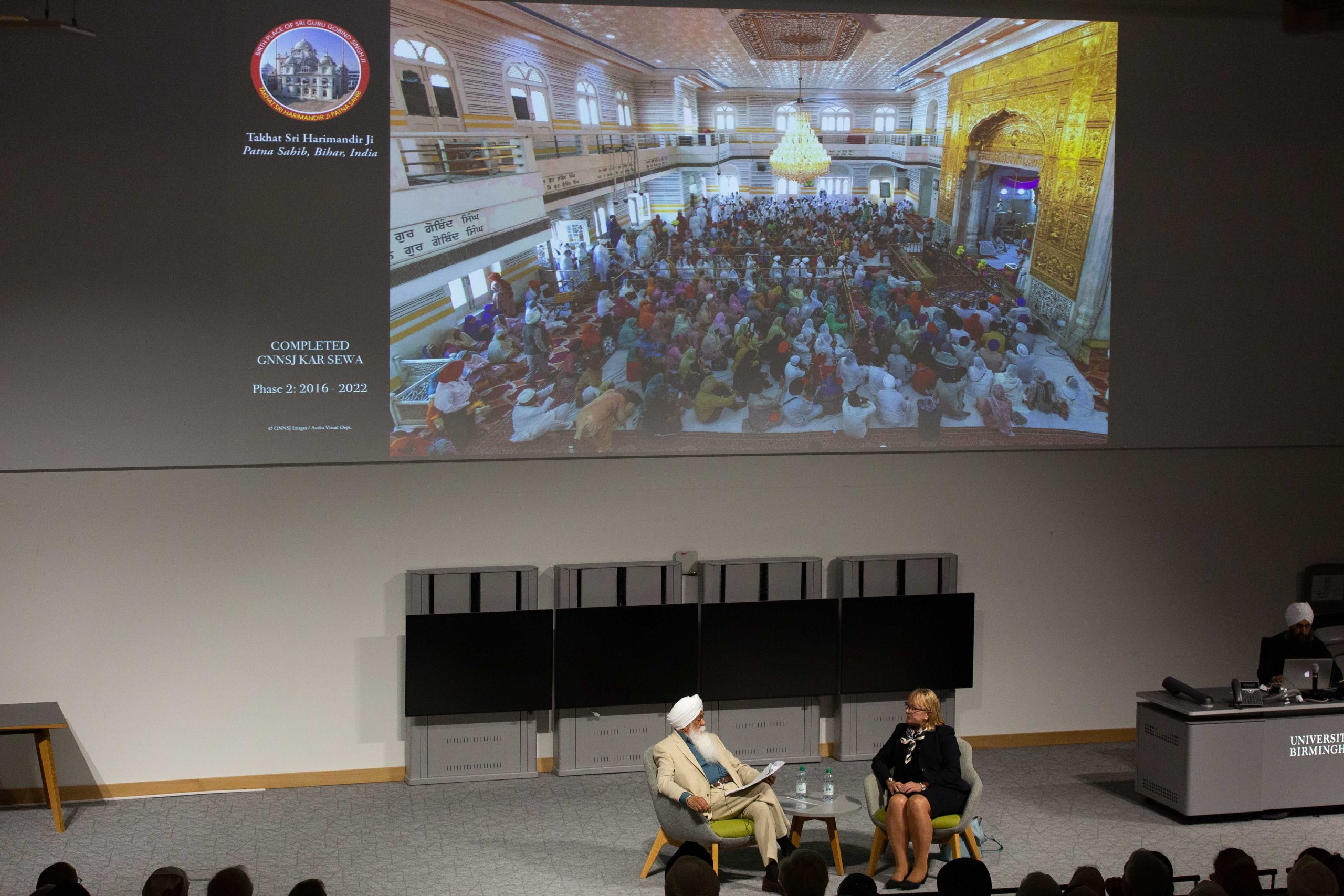
Bhai Sahib, Bhai Mohinder Singh Ji, delivered an inaugural lecture at the University of Birmingham about his life and service to both the Sikh community and the wider secular and interreligious world.
Following this lecture Bhai Sahib Ji was officially appointed as a Honorary Professor within the Theology department at the University.
‘At a time when global power struggles and conflicts continue on a daily basis, the need for ethical leadership is essential. Bhai Sahib Professor Mohinder Singh reflects on a journey of faith across three continents and beyond. He shares his experiences, learnings and insights on a remarkable life journey, with the common goal of inspiring us to live better lives, enable human flourishing, and build towards more just and peaceful societies’.
Friends, family, Nishkam School employees, delegates and sangat congregated at the University of Birmingham for the Inaugural Professorial Lecture of Bhai Sahib, Bhai Mohinder Singh Ji. The evening was blessed with recitation of kirtan by Beant Singh, Gurpreet Singh and Japnaam Kaur. Professor Robin Mason, Pro-Vice-Chancellor of the University of Birmingham, had the privilege of introducing guests to the event and joked about how Bhai Sahib Ji faced the challenge of talking about 84 years of experience in only 45 minutes. Bhai Sahib Ji would lead guests on a journey of transformative faith leadership in Handsworth, Africa and India.
A transformative childhood
Professor Charlotte Hempel, Professor of Hebrew Bible and Second Temple Judaism, Head of School of Theology at UoB, facilitated a dialogue with Bhai Sahib Ji, to bring out the details of the transformative journey. Professor Hempel first asked Bhai Sahib Ji about the key moments that shaped his childhood into adulthood. Bhai Sahib Ji answered by explaining our purpose here, our legacy to others, and being ever conscious of our mortality. Bhai Sahib Ji went on to say, ‘Sikh means lifelong learner, which I am. For Sikhs, although scholarly learning enables us to engage with the world, for us to truly flourish, we must also acquire and practice spiritual wisdom or gian. This liberates our intellect from the worst hidden human affliction, ego. It also changes how we interact in this world. It lifts us out of self-limiting habits and ignites the capacity for goodness that flickers in us all.’
Bhai Sahib Ji spoke of his birth in Uganda. His earliest memory was of a precarious journey by steamship to India, at age 3 during World War II. He would wonder why people go to war and kill one another. Soon after this journey, his mother tragically passed away which left him feeling lost and traumatised, but his friend told him it was the ‘will of God’. Losing his mum had taught him that to nurture a young child, we must identify love as the core ingredient, from both parents and others around them, alongside good nourishment.
Bhai Sahib Ji was sent to India with his siblings to be looked after by their grandparents. Here he received an abundance of love and wisdom from his grandmother. Bhai Sahib Ji mentioned, ‘It was from her that I learnt our founding prayers or mantras, the Mool Mantar and the Gur-mantar… And so, with these two mantras planted in me, and my grandmother’s love, my early initiation into my faith had begun… My grandmother, who had never been to school, used simple stories to bring the sacred to life.’
Whilst in India, Bhai Sahib Ji got typhoid followed by smallpox and was left bedridden for months. His grandmother patiently nursed them back to health and the trials of this illness started a process of healing and inner transformation. Bhai Sahib Ji mentioned, ‘This difficult stage gave me hope and faith that, even in the worst situations, things could be turned around.’ The looming partition of India led them back to Kenya. Bhai Sahib Ji’s father remarried, and their adoptive mother treated them all as one of her own. She infused values of respect, sacrifice, good manners and etiquette. His personal loss and family upheaval helped him feel more empathetic to others. Bhai Sahib Ji mentioned, ‘It made me realise too, the importance of giving children a sense of dignity – that they are valued and loved no matter what.’
A call to service
Bhai Sahib Ji spoke of his educational journey. He was 11 years old when he first attended school and thereafter qualified as a civil and structural engineer. He studied both in India and England and started work in Kenya. After getting married in 1969, he moved with his wife to Zambia where their two daughters were born and Bhai Sahib Ji had his first experience of kar sewa – which mobilises community volunteers to raise funds and develop sacred community infrastructures.
In 1972 with two close friends, Bhai Sahib Ji created the first Sikh gurudwara in Zambia’s capital city, Lusaka. After completing the gurudwara, Bhai Sahib Ji spoke of his first meeting with Sant Baba Puran Singh Ji and his initiation into the Khalsa Panth. His whole chemistry of thinking and believing changed through God’s phenomenal grace.
Bhai Sahib Ji spoke about his interactions with Baba Ji, ‘When meeting Baba Ji, I would often find myself in tears. There was something profound about his presence that made me feel literally hugged by God.’ Bhai Sahib Ji went on to mention the succession of Baba Ji to Bhai Sahib Norang Singh Ji to eventually himself in 1995.
Professor Hempel’s next line of enquiry led Bhai Sahib Ji to speak of the legacy of the Gurus, ‘to awaken us to life’s immense potential, to help us navigate all challenges and enable shared flourishing… The legacy of the Gurus’ teachings is preserved in our sacred text, the Sri Guru Granth Sahib Ji… Our scripture also includes verses from luminaries of other faiths, which strengthens the potential for inter-religious dialogue on the values most sacred to all humans.’
Bhai Sahib Ji spoke of the heritage conservation of all five of the Sikh Takhats, the five Gurudwaras of highest spiritual significance. As a result of this sewa, Bhai Sahib Ji was given the rare honour of the title ‘Bhai Sahib’ presented by the SGPC Amritsar India.
Preservation of sacred sites is key to preserving their legacies. This thinking is behind Bhai Sahib Ji’s leadership on the conservation of the 5 most important takhats (sacred thrones or Sikh seats of authority in India), as well as developing other Sikh Gurudwaras. Bhai Sahib Ji also mentioned, ‘for creating infrastructure developments in Handsworth, Birmingham, we have applied the same principles of conserving the best of the past and innovating for the future.’
Visionary leadership
Professor Hempel highlighted the selfless service Bhai Sahib Ji have led over the past 28 years, at the Gurudwara on Soho Road where there has been over 40 years of continuous prayer, 24 hours a day. Including the preparation and service of 20-25,000 meals a week, monthly amrit sanchars, and significantly increased social outreach through the Nishkam Civic Centre, Nishkam Schools Trust and Nishkam Healthcare Trust.
Bhai Sahib Ji spoke of ‘the award-winning Nishkam Centre that was designed as a centre for civic and interfaith engagement. The Centre has built partnerships and incubated projects to serve the common good. It has an action-oriented agenda to help transform lives locally and engage with others globally to share good practice to support the needs of marginalized people in a superdiverse neighbourhood.’
Bhai Sahib Ji was also asked to touch upon the virtues-led, faith-inspired education of the Nishkam Schools. Bhai Sahib Ji highlighted, ‘the spiritual teachings would prompt me to ask – between the two certain facts of our birth and death, what kind of overarching vision for education should we have? Sikh teachings remind us that every human being carries the seeds of greatness within.’
Bhai Sahib Ji ended his talk addressing thoughts and reflections about faith-inspired leadership and the formal launch of the Peace Charter at the House of Lords in the UK Parliament. He said, ‘if ever there was ever an international currency – that every person on our planet could access – for sustainable peace and prosperity, it would be the currency of values and virtues. We would plan for an economy, and for an education, where qualities like compassion, integrity, contentment, humility and loving responsibility are to be gathered, used, exchanged and invested, where the impacts of their presence of their lack are both noticed and noted to inform our next steps. It is this invisible currency of values that inspired the Peace Charter for Forgiveness and Reconciliation.’
‘Humans, from time immemorial, are on a quest for peace. The Sikh Gurus taught us that in order to create internal peace in practice, we need a toolkit of values and virtues – and to do that, we need to inwardly connect with God, the source of timeless wisdom.’


