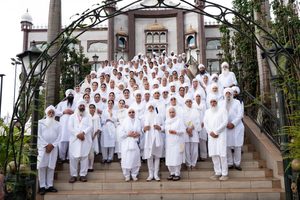
GNNSJ attended Chicago’s Parliament of World Religions with over a hundred volunteers from the UK, United States, India and Africa serving langar to an estimated 15,000 delegates across five days. GNNSJ also promoted the Peace Charter for Forgiveness and Reconciliation and displayed exhibition materials on the event theme: ‘A call to consciousness’.
Langar – Sacha Sauda
The Sikh tradition of langar was founded by Guru Nanak Dev Ji, the first Guru of the Sikhs. Guru Nanak’s father wished to introduce his growing son to the skills of business and trade, by sending him to the market to make a profit. Travelling out of town on his first trading trip, Guru Nanak invested his father’s money in feeding a group of hungry sādhūs, whom he had met along the way.
These were spiritually elevated holy people who had brought their minds into a state of graceful, enlightened control (sādh). In their gratitude for his compassionate gesture, they gave young Nanak a blessing which uplifted him and reinforced a sense of greater purpose within him.
Returning home to his father, he explained that the business of serving and supporting others brought intangible gains, and riches which lie beyond the material plane. The unseen and priceless blessing, or asīs, he had received from the sādhus made this act of serving the hungry ‘true enterprise’ or ‘sachā saudā’. This event laid the foundation of the langar tradition, where food is devotedly prepared and served in an egalitarian way to people of all backgrounds.
The practice of langar was consolidated by the second Guru, Guru Angad Dev Ji. Guru Angad Dev Ji’s wife, Mata Khivi Ji, is renowned for the sweet pudding she would make and serve within the langar.
Langar at McCormick Place
Hosted in a large marquee on the grounds outside McCormick Place’s Lakeside Centre, attendees were welcomed inside with warmth and dignity. After being invited to sit down, volunteers lovingly placed coverings to cover their heads as per Sikh tradition, before being led into the langar area, where food was served to all, regardless of background, with compassion and kindness.
Each day the langar was prepared by volunteers at the local Gurudwara before being delivered to the marquee to be served to the congregation. There was great excitement each morning in both serving and being served the Guru’s Langar, in having privilege to do both, and also by the immense feeling of love and acceptance in the sangat.
This is the third Parliament event where GNNSJ has had the privilage of serving langar, the previous being Barcelona (2004) and Salt Lake City (2015). You can learn about GNNSJ’s journey with the Parliament in the below video.
The Parliament Theme
A Call to Conscience: Defending Freedom and Human Rights was the theme of the Parliament. At a time where humanity is being threatened by terrible acts of injustice across the world, the conference addressed the urgent need for faith communities and traditions to stand up for truth, and to defend the human rights and dignity of all.
Over 7000 delegates attended the Parliament from over 95 countries, and over 210 faith traditions. There was much learning and deep appreciation of each other’s faith traditions and beliefs, and the sense of universality and oneness echoed through the various discussions, conversations, mannerisms and gestures.
Throughout the exhibitions and panel sessions held across the week urging calls to action for peace in the world, and harmony for our planet and nature, attendees sought to connect with others through gentle, kind words, and by listening and appreciating, in the hope that the electric atmosphere would spill out into the world.
On the fourth day of the Parliament, Guru Nanak Nishkam Sewak Jatha were invited to join in the sacred music concert held on the main stage in the Lakeside Centre. Acknowledging the critical need for faith traditions to work together for universal peace and harmony, the volunteers sung, with deep reverence, a shabad composed by our 10th Guru, Guru Gobind Singh Ji – Maanas Ki Jaat Ek Hi Pehchanbo: Recognise the human race as one. Nearly a hundred volunteers sang loudly behind a few leading on string instruments and a harmonium.
Peaceful Dialogue
Unity through faith was a common theme throughout the seminars and workshops. In a workshop titled Friends Across Faiths and Tributes to Ukraine, Bhai Sahib Ji referenced a shabad to reflect on the worldly concept of friendship: ‘No one is my enemy, and no one is a stranger. I get along with everyone.’ If we can accept that there are no enemies, then the concept of friendship is defined from a divine perspective. The ‘other’ is no longer a stranger, but merely the reverse of a coin, precisely because of the One God that pervades all life.
The call for solidarity was reiterated in Bhai Sahib Ji’s closing speech: ‘Such a call to conscience is much more than self reflection, it is about coming together, in solidarity, as religious people to use our faith to provide a moral compass to address the most difficult issues of our times.
A call to conscience for all of us is to be exalted for embodying the highest ideals of our different faiths to uplift humanity, promote social justice and create a more compassionate and inclusive world.’